ISOfrane® Frequently Asked Questions

FAQs

HERITAGE & STORY

Who revived ISOfrane and when?

After production ceased in the 1980s, original ISOfrane straps became collector's relics — auctioned at prices far beyond reach. In 2010, SYNCHRON the Austrian watchmaking house behind Synchron, Aquadive, and Aquastar — acquired the brand and revived it. Led by dive watch enthusiast Rick Marei (who also famously revived Doxa), Synchron reintroduced ISOfrane with the same obsessive attention to detail as the originals, while perfecting the rubber formula for even greater longevity.

Who revived ISOfrane and when?

After production ceased in the 1980s, original ISOfrane straps became collector's relics — auctioned at prices far beyond reach. In 2010, SYNCHRON  the Austrian watchmaking house behind Synchron, Aquadive, and Aquastar — acquired the brand and revived it. Led by dive watch enthusiast Rick Marei (who also famously revived Doxa), Synchron reintroduced ISOfrane with the same obsessive attention to detail as the originals, while perfecting the rubber formula for even greater longevity.

Where are ISOfrane straps made today?

Modern ISOfrane straps are crafted in Italy, where the proprietary natural rubber compound is formulated and finished to exacting standards. Italy's heritage in precision manufacturing ensures every strap upholds the quality the brand has stood for since the 1960s.

MATERIALS & CRAFTSMANSHIP

What material are ISOfrane straps made from?

Today's ISOfrane straps are made from natural rubber — not silicone, not synthetic alternatives. Natural rubber offers an exceptional combination of suppleness, grip, and tactile warmth that synthetic materials simply cannot replicate. It moulds gently to the wrist over time, becoming more comfortable with every wear. The compound is PFAS-free and non-toxic, making it as responsible a choice as it is a pleasurable one.

Natural rubber perishes — how does ISOfrane prevent that?

Natural rubber on its own will crack, harden, and perish over time when exposed to UV light, ozone, heat, and oils. ISOfrane addresses this with a proprietary blend of formula additives developed specifically to counteract these vulnerabilities — stabilising the compound against oxidation, UV degradation, and environmental stress. Crucially, these additives are PFAS-free and entirely non-toxic, so there is no trade-off between performance and safety. The result is a strap that retains the luxurious feel of natural rubber while offering a lifespan that far exceeds untreated rubber or common silicone alternatives.

What does PFAS-free mean and why does it matter?

PFAS (per- and polyfluoroalkyl substances) are a class of synthetic chemicals widely used in manufacturing for their water and heat resistance. They are persistent in the environment and in the human body, earning them the nickname 'forever chemicals', and are increasingly linked to health concerns with long-term exposure. Many rubber and coating products still rely on them. ISOfrane's natural rubber compound contains no PFAS whatsoever — a deliberate formulation choice that means the strap is safe against your skin day after day, dive after dive, without compromise.

Why is natural rubber better than silicone for a watch strap?

Silicone is inexpensive and technically waterproof, but it attracts dust and lint, feels plasticky against the skin, and lacks structural integrity under tension. Natural rubber has a living quality to it — it flexes without resistance, grips the wrist without sticking, and develops a subtle patina with age. Combined with ISOfrane's PFAS-free, non-toxic anti-perishing additives, it delivers a wearing experience no silicone strap can match.

Is ISOfrane hypoallergenic and safe to wear?

Yes, completely. ISOfrane straps are 100% silicone-free, PFAS-free, and non-toxic. The proprietary formula has been developed with skin safety as a priority, making it suitable for everyday wear even for those with sensitivities. The strap does not attract dust or lint, and the textured underside prevents it from adhering uncomfortably to skin.

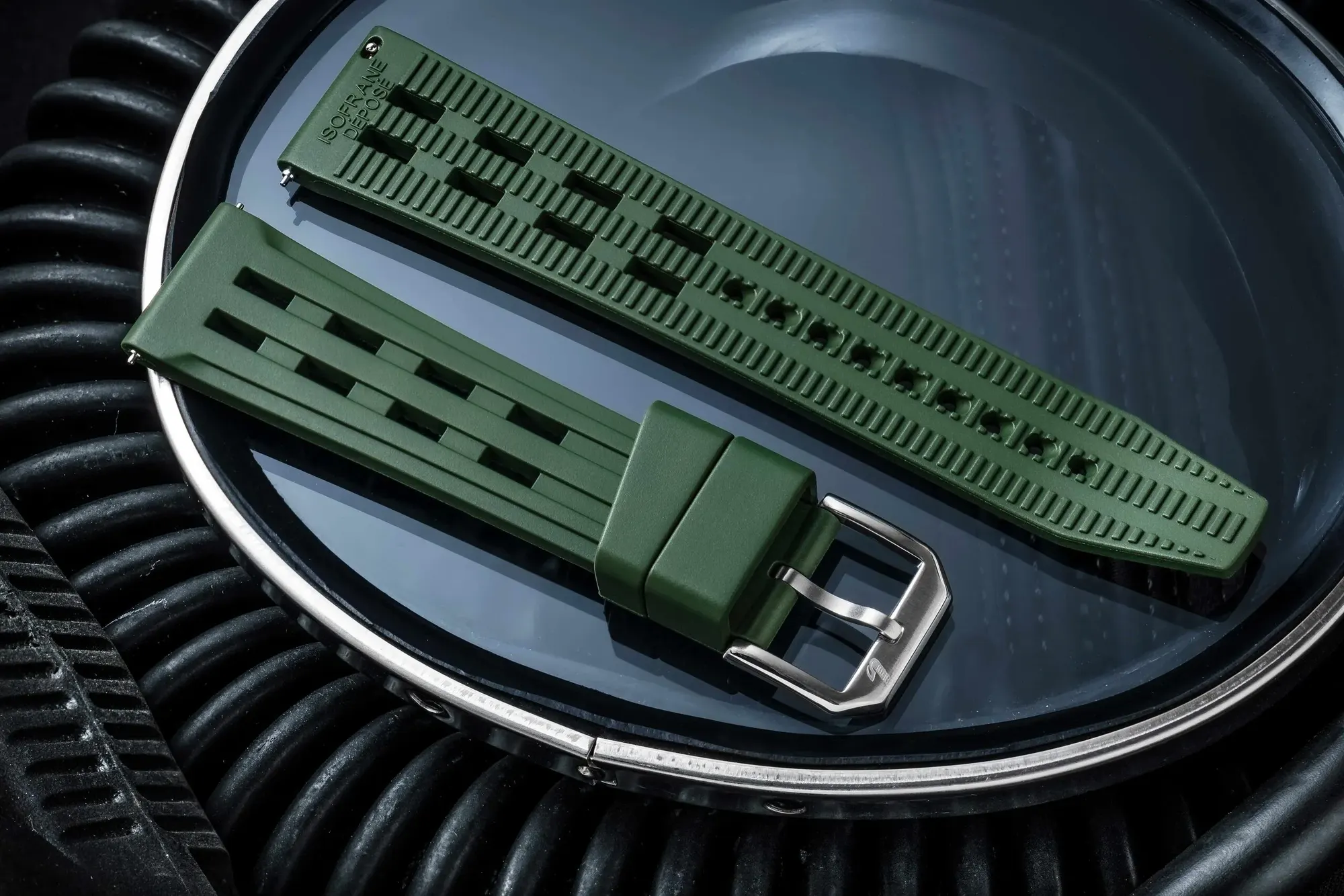
What is the ventilation slot design for?

The iconic ladder-style ventilation slots are functional engineering at its finest. The slots allow airflow across the wrist, prevent moisture buildup, and ensure water drains instantly when diving. The ribbed textured underside stops the strap adhering to skin, while the natural rubber compound flexes with the wrist rather than against it — a combination that has never needed improving since its introduction.

SIZING & FIT

What lug widths are available?

ISOfrane straps are available in standard dive watch lug widths, most commonly 20mm, 22mm, and 24mm. The 24mm 'ladder' strap is the most iconic format, synonymous with the original Omega PloProf. Check the product pages for current availability in each width.

How should an ISOfrane strap fit on the wrist?

ISOfrane straps are designed with micro-adjustability in mind. The tang hole spacing is closer than standard straps, allowing a more precise fit. Crucially, the natural rubber compound has an inherent 'give' — it expands and contracts with temperature changes and wrist swelling, which is especially useful when transitioning between cold water and warm air while diving. Choose the hole that feels comfortably snug, not tight.

SHIPPING & RETURNS

Does ISOfrane ship internationally?

Yes. ISOfrane straps are available worldwide through isofrane.com and authorised retailers. Shipping times and costs vary by destination. For the most current shipping options and rates, please refer to the checkout page or contact the ISOfrane team directly.

What is the return policy?

ISOfrane stands behind the quality of every strap. If you receive a defective item or are unsatisfied with your order, please contact the ISOfrane team within 14 days of receipt to discuss a return or exchange. Items must be unworn and in original packaging. For the most up-to-date return policy, visit the Returns page on the website.

CARE & MAINTENANCE

How do I clean my ISOfrane strap?

ISOfrane straps are remarkably low-maintenance. After diving or heavy use, rinse with fresh water and allow to air dry away from direct sunlight. For a deeper clean, mild soap and warm water is all that is needed. Avoid harsh solvents, bleach, or petroleum-based cleaners, which can strip the protective additives from the natural rubber compound.

How long will my ISOfrane strap last?

Thanks to the proprietary anti-perishing additives, a well-maintained ISOfrane strap will outlast the vast majority of rubber and silicone straps on the market. The natural rubber resists cracking, hardening, and UV degradation far beyond what untreated rubber could achieve. Store in a cool, dry place away from prolonged sunlight when not in use, and the strap will reward you with years — potentially decades — of wear.

Can I wear my ISOfrane strap in salt water or chlorinated pools?

Absolutely — it was made for exactly this. The natural rubber compound, fortified with ISOfrane's protective additives, is resistant to salt water and chlorine. Simply rinse with fresh water afterward to remove any residue and preserve the rubber. The strap will not stiffen, discolour, or degrade from regular aquatic use.